

The Project Gutenberg eBook of A Horse's Tale, by Mark Twain
A Horse’s Tale
BY
Mark Twain
ILLUSTRATEDBY
LUCIUS HITCHCOCK
LONDON AND NEW YORK
HARPER & BROTHERS
PUBLISHERS .. MCMVII
Copyright, 1906, by Harper &Brothers.
Allrights reserved
PublishedOctober, 1907.
Printed in United States ofAmerica.
Contents
| Chapter I. Soldier Boy—Privately to Himself |
| Chapter II. Letter from Rouen—To General Alison |
| Chapter III. General Alison to his Mother |
| Chapter IV. Cathy to her Aunt Mercedes |
| Chapter V. General Alison to Mercedes |
| Chapter VI. Soldier Boy and the Mexican Plug |
| Chapter VII. Soldier Boy and Shekels |
| Chapter VIII. The Scout-start. BB and Lieutenant-General Alison |
| Chapter IX. Soldier Boy and Shekels Again |
| Chapter X. General Alison and Dorcas |
| Chapter XI. Several Months Later. Antonio and Thorndike |
| Chapter XII. Mongrel and the Other Horse |
| Chapter XIII. General Alison to his Mother |
| Chapter XIV. Soldier Boy—To Himself |
| Chapter XV. General Alison to Mrs. Drake, the Colonel’s Wife |
Illustrations
| “Buffalo Bill took me on Soldier Boy to Thunder-Bird’s Camp” |
| “Look at that file of cats in your chair” |
| “Every morning they go clattering down into the plain” |
| “There was nothing to do but stand by” |
| “His strength failed and he fell at her feet” |
Acknowledgements
Although I have had several opportunities to see a bull-fight,I have never seen one; but I needed a bull-fight in this book,and a trustworthy one will be found in it. I got it out ofJohn Hay’s Castilian Days, reducing and condensingit to fit the requirements of this small story. Mr. Hay andI were friends from early times, and if he were still with us hewould not rebuke me for the liberty I have taken.
The knowledge of military minutiæ exhibited in this bookwill be found to be correct, but it is not mine; I took it fromArmy Regulations, ed. 1904; Hardy’sTactics—Cavalry, revised ed., 1861; andJomini’s Handbook of Military Etiquette, West Pointed., 1905.
It would not be honest in me to encourage by silence theinference that I composed the Horse’s private bugle-call,for I did not. I lifted it, as Aristotle says. It isthe opening strain in The Pizzicatoin Sylvia, byDelibes. When that master was composing it he did not knowit was a bugle-call, it was I that found it out.
Along through the book I have distributed a few anachronismsand unborn historical incidents and such things, so as to helpthe tale over the difficult places. This idea is notoriginal with me; I got it out of Herodotus. Herodotussays, “Very few things happen at the right time, and therest do not happen at all: the conscientious historian willcorrect these defects.”
The cats in the chair do not belong to me, but to another.
These are all the exceptions. What is left of the bookis mine.
MARK TWAIN.
Lone Tree Hill, Dublin,
New Hampshire, October,1905.
Part I
I
SOLDIER BOY—PRIVATELY TOHIMSELF
I am Buffalo Bill’shorse. I have spent my life under his saddle—with himin it, too, and he is good for two hundred pounds, without hisclothes; and there is no telling how much he does weigh when heis out on the war-path and has his batteries belted on. Heis over six feet, is young, hasn’t an ounce of waste flesh,is straight, graceful, springy in his motions, quick as a cat,and has a handsome face, and black hair dangling down on hisshoulders, and is beautiful to look at; and nobody is braver thanhe is, and nobody is stronger, except myself. Yes, a personthat doubts that he is fine to see should see him in his beadedbuck-skins, on my back and his rifle peeping above his shoulder,chasing a hostile trail, with me going like the wind and his hairstreaming out behind from the shelter of his broad slouch.Yes, he is a sight to look at then—and I’m part of itmyself.
I am his favorite horse, out of dozens. Big as he is, Ihave carried him eighty-one miles between nightfall and sunriseon the scout; and I am good for fifty, day in and day out, andall the time. I am not large, but I am built on a businessbasis. I have carried him thousands and thousands of mileson scout duty for the army, and there’s not a gorge, nor apass, nor a valley, nor a fort, nor a trading post, nor abuffalo-range in the whole sweep of the Rocky Mountains and theGreat Plains that we don’t know as well as we know thebugle-calls. He is Chief of Scouts to the Army of theFrontier, and it makes us very important. In such aposition as I hold in the military service one needs to be ofgood family and possess an education much above the common to beworthy of the place. I am the best-educated horse outsideof the hippodrome, everybody says, and the best-mannered.It may be so, it is not for me to say; modesty is the bestpolicy, I think. Buffalo Bill taught me the most of what Iknow, my mother taught me much, and I taught myself therest. Lay a row of moccasins before me—Pawnee, Sioux,Shoshone, Cheyenne, Blackfoot, and as many other tribes as youplease—and I can name the tribe every moccasin belongs toby the make of it. Name it in horse-talk, and could do itin American if I had speech.
I know some of the Indian signs—the signs they make withtheir hands, and by signal-fires at night and columns of smoke byday. Buffalo Bill taught me how to drag wounded soldiersout of the line of fire with my teeth; and I’ve done it,too; at least I’ve dragged himout of the battlewhen he was wounded. And not just once, but twice.Yes, I know a lot of things. I remember forms, and gaits,and faces; and you can’t disguise a person that’sdone me a kindness so that I won’t know him thereafterwherever I find him. I know the art of searching for atrail, and I know the stale track from the fresh. I cankeep a trail all by myself, with Buffalo Bill asleep in thesaddle; ask him—he will tell you so. Many a time,when he has ridden all night, he has said to me at dawn,“Take the watch, Boy; if the trail freshens, callme.” Then he goes to sleep. He knows he cantrust me, because I have a reputation. A scout horse thathas a reputation does not play with it.
My mother was all American—no alkali-spider abouther, I can tell you; she was of the best blood ofKentucky, the bluest Blue-grass aristocracy, very proud andacrimonious—or maybe it is ceremonious. I don’tknow which it is. But it is no matter; size is the mainthing about a word, and that one’s up to standard.She spent her military life as colonel of the Tenth Dragoons, andsaw a deal of rough service—distinguished service it was,too. I mean, she carriedthe Colonel; but it’sall the same. Where would he be without his horse? Hewouldn’t arrive. It takes two to make a colonel ofdragoons. She was a fine dragoon horse, but never got abovethat. She was strong enough for the scout service, and hadthe endurance, too, but she couldn’t quite come up to thespeed required; a scout horse has to have steel in his muscle andlightning in his blood.
My father was a bronco. Nothing as to lineage—thatis, nothing as to recent lineage—but plenty good enoughwhen you go a good way back. When Professor Marsh was outhere hunting bones for the chapel of Yale University he foundskeletons of horses no bigger than a fox, bedded in the rocks,and he said they were ancestors of my father. My motherheard him say it; and he said those skeletons were two millionyears old, which astonished her and made her Kentucky pretensionslook small and pretty antiphonal, not to say oblique. Letme see. . . . I used to know the meaning of those words, but . .. well, it was years ago, and ’tisn’t as vivid now asit was when they were fresh. That sort of wordsdoesn’t keep, in the kind of climate we have outhere. Professor Marsh said those skeletons werefossils. So that makes me part blue grass and part fossil;if there is any older or better stock, you will have to look forit among the Four Hundred, I reckon. I am satisfied withit. And am a happy horse, too, though born out ofwedlock.
And now we are back at Fort Paxton once more, after aforty-day scout, away up as far as the Big Horn. Everythingquiet. Crows and Blackfeet squabbling—asusual—but no outbreaks, and settlers feeling fairlyeasy.
The Seventh Cavalry still in garrison, here; also the NinthDragoons, two artillery companies, and some infantry. Allglad to see me, including General Alison, commandant. Theofficers’ ladies and children well, and called uponme—with sugar. Colonel Drake, Seventh Cavalry, saidsome pleasant things; Mrs. Drake was very complimentary; alsoCaptain and Mrs. Marsh, Company B, Seventh Cavalry; also theChaplain, who is always kind and pleasant to me, because I kickedthe lungs out of a trader once. It was Tommy Drake andFanny Marsh that furnished the sugar—nice children, thenicest at the post, I think.
That poor orphan child is on her way fromFrance—everybody is full of the subject. Her fatherwas General Alison’s brother; married a beautiful youngSpanish lady ten years ago, and has never been in Americasince. They lived in Spain a year or two, then went toFrance. Both died some months ago. This little girlthat is coming is the only child. General Alison is glad tohave her. He has never seen her. He is a very niceold bachelor, but is an old bachelor just the same andisn’t more than about a year this side of retirement by agelimit; and so what does he know about taking care of a littlemaid nine years old? If I could have her it would beanother matter, for I know all about children, and they adoreme. Buffalo Bill will tell you so himself.
I have some of this news from over-hearing thegarrison-gossip, the rest of it I got from Potter, theGeneral’s dog. Potter is the great Dane. He isprivileged, all over the post, like Shekels, the SeventhCavalry’s dog, and visits everybody’s quarters andpicks up everything that is going, in the way of news.Potter has no imagination, and no great deal of culture, perhaps,but he has a historical mind and a good memory, and so he is theperson I depend upon mainly to post me up when I get back from ascout. That is, if Shekels is out on depredation and Ican’t get hold of him.
II
LETTER FROM ROUEN—TO GENERALALISON
MydearBrother-in-Law,—Please let me write again in Spanish, Icannot trust my English, and I am aware, from what your brotherused to say, that army officers educated at the Military Academyof the United States are taught our tongue. It is as I toldyou in my other letter: both my poor sister and her husband, whenthey found they could not recover, expressed the wish that youshould have their little Catherine—as knowing that youwould presently be retired from the army—rather than thatshe should remain with me, who am broken in health, or go to yourmother in California, whose health is also frail.
You do not know the child, therefore I must tell you somethingabout her. You will not be ashamed of her looks, for she isa copy in little of her beautiful mother—and it is thatAndalusian beauty which is not surpassable, even in yourcountry. She has her mother’s charm and grace andgood heart and sense of justice, and she has her father’svivacity and cheerfulness and pluck and spirit of enterprise,with the affectionate disposition and sincerity of bothparents.
My sister pined for her Spanish home all these years of exile;she was always talking of Spain to the child, and tending andnourishing the love of Spain in the little thing’s heart asa precious flower; and she died happy in the knowledge that thefruitage of her patriotic labors was as rich as even she coulddesire.
Cathy is a sufficiently good little scholar, for her nineyears; her mother taught her Spanish herself, and kept it alwaysfresh upon her ear and her tongue by hardly ever speaking withher in any other tongue; her father was her English teacher, andtalked with her in that language almost exclusively; French hasbeen her everyday speech for more than seven years among herplaymates here; she has a good working use ofgoverness—German and Italian. It is true that thereis always a faint foreign fragrance about her speech, no matterwhat language she is talking, but it is only just noticeable,nothing more, and is rather a charm than a mar, I think. Inthe ordinary child-studies Cathy is neither before nor behind theaverage child of nine, I should say. But I can say this forher: in love for her friends and in high-mindedness andgood-heartedness she has not many equals, and in my opinion nosuperiors. And I beg of you, let her have her way with thedumb animals—they are her worship. It is aninheritance from her mother. She knows but little ofcruelties and oppressions—keep them from her sight if youcan. She would flare up at them and make trouble, in hersmall but quite decided and resolute way; for she has a characterof her own, and lacks neither promptness nor initiative.Sometimes her judgment is at fault, but I think her intentionsare always right. Once when she was a little creature ofthree or four years she suddenly brought her tiny foot down uponthe floor in an apparent outbreak of indignation, then fetched ita backward wipe, and stooped down to examine the result.Her mother said:
“Why, what is it, child? What has stirred youso?”
“Mamma, the big ant was trying to kill the littleone.”
“And so you protected the little one.”
“Yes, mamma, because he had no friend, and Iwouldn’t let the big one kill him.”
“But you have killed them both.”
Cathy was distressed, and her lip trembled. She pickedup the remains and laid them upon her palm, and said:
“Poor little anty, I’m so sorry; and Ididn’t mean to kill you, but there wasn’t any otherway to save you, it was such a hurry.”
She is a dear and sweet little lady, and when she goes it willgive me a sore heart. But she will be happy with you, andif your heart is old and tired, give it into her keeping; shewill make it young again, she will refresh it, she will make itsing. Be good to her, for all our sakes!
My exile will soon be over now. As soon as I am a littlestronger I shall see my Spain again; and that will make me youngagain!
Mercedes.
III
GENERAL ALISON TO HIS MOTHER
I am glad to know that you are allwell, in San Bernardino.
. . . That grandchild of yours has been here—well, I donot quite know how many days it is; nobody can keep account ofdays or anything else where she is! Mother, she did whatthe Indians were never able to do. She took theFort—took it the first day! Took me, too; took thecolonels, the captains, the women, the children, and the dumbbrutes; took Buffalo Bill, and all his scouts; took thegarrison—to the last man; and in forty-eight hours theIndian encampment was hers, illustrious old Thunder-Bird andall. Do I seem to have lost my solemnity, my gravity, mypoise, my dignity? You would lose your own, in mycircumstances. Mother, you never saw such a winning littledevil. She is all energy, and spirit, and sunshine, andinterest in everybody and everything, and pours out her prodigallove upon every creature that will take it, high or low,Christian or pagan, feathered or furred; and none has declined itto date, and none ever will, I think. But she has a temper,and sometimes it catches fire and flames up, and is likely toburn whatever is near it; but it is soon over, the passion goesas quickly as it comes. Of course she has an Indian namealready; Indians always rechristen a stranger early.Thunder-Bird attended to her case. He gave her the Indianequivalent for firebug, or fire-fly. He said:
“’Times, ver’ quiet, ver’ soft, likesummer night, but when she mad she blaze.”
Isn’t it good? Can’t you see theflare? She’s beautiful, mother, beautiful as apicture; and there is a touch of you in her face, and of herfather—poor George! and in her unresting activities, andher fearless ways, and her sunbursts and cloudbursts, she isalways bringing George back to me. These impulsive naturesare dramatic. George was dramatic, so is thisLightning-Bug, so is Buffalo Bill. When Cathy firstarrived—it was in the forenoon—Buffalo Bill was away,carrying orders to Major Fuller, at Five Forks, up in the ClaytonHills. At mid-afternoon I was at my desk, trying to work,and this sprite had been making it impossible for half anhour. At last I said:
“Oh, you bewitching little scamp, can’tyoube quiet just a minute or two, and let your poor old uncle attendto a part of his duties?”
“I’ll try, uncle; I will, indeed,” shesaid.
“Well, then, that’s a good child—kissme. Now, then, sit up in that chair, and set your eye onthat clock. There—that’s right. If youstir—if you so much as wink—for four whole minutes,I’ll bite you!”
It was very sweet and humble and obedient she looked, sittingthere, still as a mouse; I could hardly keep from setting herfree and telling her to make as much racket as she wantedto. During as much as two minutes there was a mostunnatural and heavenly quiet and repose, then Buffalo Bill camethundering up to the door in all his scout finery, flung himselfout of the saddle, said to his horse, “Wait for me,Boy,” and stepped in, and stopped dead in histracks—gazing at the child. She forgot orders, andwas on the floor in a moment, saying:
“Oh, you are so beautiful! Do you likeme?”
“No, I don’t, I love you!” and he gatheredher up with a hug, and then set her on hisshoulder—apparently nine feet from the floor.
She was at home. She played with his long hair, andadmired his big hands and his clothes and his carbine, and askedquestion after question, as fast as he could answer, until Iexcused them both for half an hour, in order to have a chance tofinish my work. Then I heard Cathy exclaiming over SoldierBoy; and he was worthy of her raptures, for he is a wonder of ahorse, and has a reputation which is as shining as his own silkenhide.
IV
CATHY TO HER AUNT MERCEDES
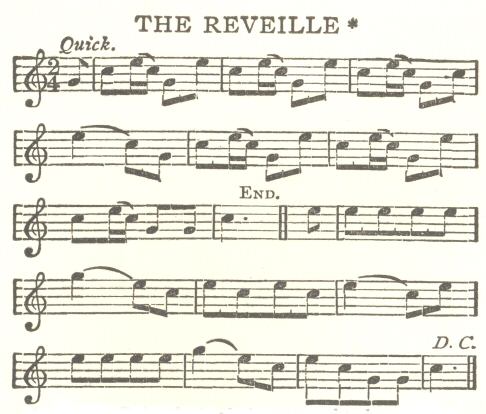
Oh, it is wonderful here, auntydear, just paradise! Oh, if you could only see it!everything so wild and lovely; such grand plains, stretching suchmiles and miles and miles, all the most delicious velvety sandand sage-brush, and rabbits as big as a dog, and such tall andnoble jackassful ears that that is what they name them by; andsuch vast mountains, and so rugged and craggy and lofty, withcloud-shawls wrapped around their shoulders, and looking sosolemn and awful and satisfied; and the charming Indians, oh, howyou would dote on them, aunty dear, and they would on you, too,and they would let you hold their babies, the way they do me, andthey arethe fattest, and brownest, and sweetest littlethings, and never cry, and wouldn’t if they had pinssticking in them, which they haven’t, because they are poorand can’t afford it; and the horses and mules and cattleand dogs—hundreds and hundreds and hundreds, and not ananimal that you can’t do what you please with, except uncleThomas, but Idon’t mind him, he’s lovely; andoh, if you could hear the bugles:too—too—too-too—too—too, and soon—perfectly beautiful! Do you recognize thatone? It’s the first toots of the reveille; itgoes, dear me, soearly in the morning!—then I andevery other soldier on the whole place are up and out in aminute, except uncle Thomas, who is most unaccountably lazy, Idon’t know why, but I have talked to him about it, and Ireckon it will be better, now. He hasn’t any faultsmuch, and is charming and sweet, like Buffalo Bill, andThunder-Bird, and Mammy Dorcas, and Soldier Boy, and Shekels, andPotter, and Sour-Mash, and—well, they’re allthat, just angels, as you may say.
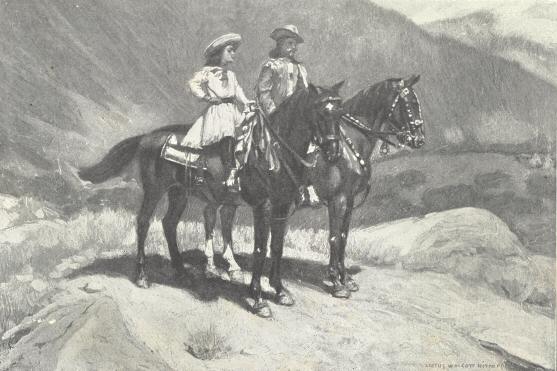
The very first day I came, I don’t know how long ago itwas, Buffalo Bill took me on Soldier Boy to Thunder-Bird’scamp, not the big one which is out on the plain, which is WhiteCloud’s, he took me to thatone next day, but thisone is four or five miles up in the hills and crags, where thereis a great shut-in meadow, full of Indian lodges and dogs andsquaws and everything that is interesting, and a brook of theclearest water running through it, with white pebbles on thebottom and trees all along the banks cool and shady and good towade in, and as the sun goes down it is dimmish in there, butaway up against the sky you see the big peaks towering up andshining bright and vivid in the sun, and sometimes an eaglesailing by them, not flapping a wing, the same as if he wasasleep; and young Indians and girls romping and laughing andcarrying on, around the spring and the pool, and not much clotheson except the girls, and dogs fighting, and the squaws busy atwork, and the bucks busy resting, and the old men sitting in abunch smoking, and passing the pipe not to the left but to theright, which means there’s been a row in the camp and theyare settling it if they can, and children playing justthesame as any other children, and little boys shooting at a markwith bows, and I cuffed one of them because he hit a dog with aclub that wasn’t doing anything, and he resented it butbefore long he wished he hadn’t: but this sentence isgetting too long and I will start another. Thunder-Bird puton his Sunday-best war outfit to let me see him, and he wassplendid to look at, with his face painted red and bright andintense like a fire-coal and a valance of eagle feathers from thetop of his head all down his back, and he had his tomahawk, too,and his pipe, which has a stem which is longer than my arm, and Inever had such a good time in an Indian camp in my life, and Ilearned a lot of words of the language, and next day BB took meto the camp out on the Plains, four miles, and I had another goodtime and got acquainted with some more Indians and dogs; and thebig chief, by the name of White Cloud, gave me a pretty littlebow and arrows and I gave him my red sash-ribbon, and in fourdays I could shoot very well with it and beat any white boy of mysize at the post; and I have been to those camps plenty of timessince; and I have learned to ride, too, BB taught me, and everyday he practises me and praises me, and every time I do betterthan ever he lets me have a scamper on Soldier Boy, andthat’sthe last agony of pleasure! for he is thecharmingest horse, and so beautiful and shiny and black, andhasn’t another color on him anywhere, except a white starin his forehead, not just an imitation star, but a real one, withfour points, shaped exactly like a star that’s hand-made,and if you should cover him all up but his star you would knowhim anywhere, even in Jerusalem or Australia, by that. AndI got acquainted with a good many of the Seventh Cavalry, and thedragoons, and officers, and families, and horses, in the firstfew days, and some more in the next few and the next few and thenext few, and now I know more soldiers and horses than you canthink, no matter how hard you try. I am keeping up mystudies every now and then, but there isn’t much time forit. I love you so! and I send you a hug and a kiss.
Cathy.
P.S.—I belong to the Seventh Cavalry and Ninth Dragoons,I am an officer, too, and do not have to work on account of notgetting any wages.
>V
GENERAL ALISON TO MERCEDES
She has been with us a good nicelong time, now. You are troubled about your sprite becausethis is such a wild frontier, hundreds of miles fromcivilization, and peopled only by wandering tribes ofsavages? You fear for her safety? Give yourself nouneasiness about her. Dear me, she’s in a nursery!and she’s got more than eighteen hundred nurses. Itwould distress the garrison to suspect that you think theycan’t take care of her. They think they can.They would tell you so themselves. You see, the SeventhCavalry has never had a child of its very own before, and neitherhas the Ninth Dragoons; and so they are like all new mothers,they think there is no other child like theirs, no other child sowonderful, none that is so worthy to be faithfully and tenderlylooked after and protected. These bronzed veterans of mineare very good mothers, I think, and wiser than some othermothers; for they let her take lots of risks, and it is a goodeducation for her; and the more risks she takes and comessuccessfully out of, the prouder they are of her. Theyadopted her, with grave and formal military ceremonies of theirown invention—solemnities is the truer word; solemnitiesthat were so profoundly solemn and earnest, that the spectaclewould have been comical if it hadn’t been sotouching. It was a good show, and as stately and complex asguard-mount and the trooping of the colors; and it had its ownspecial music, composed for the occasion by the bandmaster of theSeventh; and the child was as serious as the most seriouswar-worn soldier of them all; and finally when they throned herupon the shoulder of the oldest veteran, and pronounced her“well and truly adopted,” and the bands struck up andall saluted and she saluted in return, it was better and moremoving than any kindred thing I have seen on the stage, becausestage things are make-believe, but this was real and theplayers’ hearts were in it.
It happened several weeks ago, and was followed by someadditional solemnities. The men created a couple of newranks, thitherto unknown to the army regulations, and conferredthem upon Cathy, with ceremonies suitable to a duke. So nowshe is Corporal-General of the Seventh Cavalry, andFlag-Lieutenant of the Ninth Dragoons, with the privilege(decreed by the men) of writing U.S.A. after her name!Also, they presented her a pair of shoulder-straps—bothdark blue, the one with F. L. on it, the other with C. G.Also, a sword. She wears them. Finally, they grantedher the salute. I am witness that that ceremony isfaithfully observed by both parties—and most gravely anddecorously, too. I have never seen a soldier smile yet,while delivering it, nor Cathy in returning it.
Ostensibly I was not present at these proceedings, and amignorant of them; but I was where I could see. I was afraidof one thing—the jealousy of the other children of thepost; but there is nothing of that, I am glad to say. Onthe contrary, they are proud of their comrade and herhonors. It is a surprising thing, but it is true. Thechildren are devoted to Cathy, for she has turned their dullfrontier life into a sort of continuous festival; also they knowher for a stanch and steady friend, a friend who can always bedepended upon, and does not change with the weather.
She has become a rather extraordinary rider, under thetutorship of a more than extraordinary teacher—BB, which isher pet name for Buffalo Bill. She pronounces itbeeby. He has not only taught her seventeen ways ofbreaking her neck, but twenty-two ways of avoiding it. Hehas infused into her the best and surest protection of ahorseman—confidence. He did it gradually,systematically, little by little, a step at a time, and each stepmade sure before the next was essayed. And so he inched heralong up through terrors that had been discounted by trainingbefore she reached them, and therefore were not recognizable asterrors when she got to them. Well, she is a daring littlerider, now, and is perfect in what she knows ofhorsemanship. By-and-by she will know the art like a WestPoint cadet, and will exercise it as fearlessly. Shedoesn’t know anything about side-saddles. Does thatdistress you? And she is a fine performer, without anysaddle at all. Does that discomfort you? Do not letit; she is not in any danger, I give you my word.
You said that if my heart was old and tired she would refreshit, and you said truly. I do not know how I got alongwithout her, before. I was a forlorn old tree, but now thatthis blossoming vine has wound itself about me and become thelife of my life, it is very different. As a furnisher ofbusiness for me and for Mammy Dorcas she is exhaustlesslycompetent, but I like my share of it and of course Dorcas likeshers, for Dorcas “raised” George, and Cathy is Georgeover again in so many ways that she brings back Dorcas’syouth and the joys of that long-vanished time. My fathertried to set Dorcas free twenty years ago, when we still lived inVirginia, but without success; she considered herself a member ofthe family, and wouldn’t go. And so, a member of thefamily she remained, and has held that position unchallenged eversince, and holds it now; for when my mother sent her here fromSan Bernardino when we learned that Cathy was coming, she onlychanged from one division of the family to the other. Shehas the warm heart of her race, and its lavish affections, andwhen Cathy arrived the pair were mother and child in fiveminutes, and that is what they are to date and willcontinue. Dorcas really thinks she raised George, and thatis one of her prides, but perhaps it was a mutual raising, fortheir ages were the same—thirteen years short ofmine. But they were playmates, at any rate; as regardsthat, there is no room for dispute.
Cathy thinks Dorcas is the best Catholic in America exceptherself. She could not pay any one a higher compliment thanthat, and Dorcas could not receive one that would please herbetter. Dorcas is satisfied that there has never been amore wonderful child than Cathy. She has conceived thecurious idea that Cathy is twins, and that one of them isa boy-twin and failed to get segregated—got submerged, isthe idea. To argue with her that this is nonsense is awaste of breath—her mind is made up, and arguments do notaffect it. She says:
“Look at her; she loves dolls, and girl-plays, andeverything a girl loves, and she’s gentle and sweet, andain’t cruel to dumb brutes—now that’s thegirl-twin, but she loves boy-plays, and drums and fifes andsoldiering, and rough-riding, and ain’t afraid of anybodyor anything—and that’s the boy-twin; ’deed youneedn’t tell meshe’s only onechild;no, sir, she’s twins, and one of them got shet up out ofsight. Out of sight, but that don’t make anydifference, that boy is in there, and you can see him look out ofher eyes when her temper is up.”
Then Dorcas went on, in her simple and earnest way, to furnishillustrations.
“Look at that raven, Marse Tom. Would anybodybefriend a raven but that child? Of course theywouldn’t; it ain’t natural. Well, the Injun boyhad the raven tied up, and was all the time plaguing it andstarving it, and she pitied the po’ thing, and tried to buyit from the boy, and the tears was in her eyes. That wasthe girl-twin, you see. She offered him her thimble, and heflung it down; she offered him all the doughnuts she had, whichwas two, and he flung them down; she offered him half a paper ofpins, worth forty ravens, and he made a mouth at her and jabbedone of them in the raven’s back. That was the limit,you know. It called for the other twin. Her eyesblazed up, and she jumped for him like a wild-cat, and when shewas done with him she was rags and he wasn’t anything butan allegory. That was most undoubtedly the other twin, yousee, coming to the front. No, sir; don’t tellmehe ain’t in there. I’ve seen him withmy own eyes—and plenty of times, at that.”
“Allegory? What is an allegory?”
“I don’t know, Marse Tom, it’s one of herwords; she loves the big ones, you know, and I pick them up fromher; they sound good and I can’t help it.”
“What happened after she had converted the boy into anallegory?”
“Why, she untied the raven and confiscated him by forceand fetched him home, and left the doughnuts and things on theground. Petted him, of course, like she does with everycreature. In two days she had him so stuck after her thatshe—well, youknow how he follows her everywhere,and sets on her shoulder often when she rides her breakneckrampages—all of which is the girl-twin to the front, yousee—and he does what he pleases, and is up to all kinds ofdevilment, and is a perfect nuisance in the kitchen. Well,they all stand it, but they wouldn’t if it was anotherperson’s bird.”
Here she began to chuckle comfortably, and presently shesaid:
“Well, you know, she’s a nuisance herself, MissCathy is, she isso busy, and into everything, like thatbird. It’s all just as innocent, you know, and shedon’t mean any harm, and is so good and dear; and itain’t her fault, it’s her nature; her interest isalways a-working and always red-hot, and she can’t keepquiet. Well, yesterday it was ‘Please, Miss Cathy,don’t do that’; and, ‘Please, Miss Cathy, letthat alone’; and, ‘Please, Miss Cathy, don’tmake so much noise’; and so on and so on, till I reckon Ihad found fault fourteen times in fifteen minutes; then shelooked up at me with her big brown eyes that can plead so, andsaid in that odd little foreign way that goes to your heart,
“’Please, mammy, make me a compliment.”
“And of course you did it, you old fool?”
“Marse Tom, I just grabbed her up to my breast and says,‘Oh, you po’ dear little motherless thing, youain’t got a fault in the world, and you can do anything youwant to, and tear the house down, and yo’ old black mammywon’t say a word!’”
“Why, of course, of course—Iknewyou’d spoil the child.”
She brushed away her tears, and said with dignity:
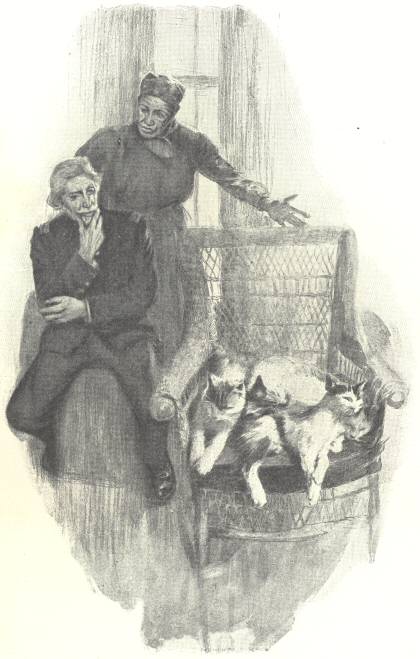
“Spoil the child? spoil thatchild, MarseTom? There can’t anybodyspoil her.She’s the king bee of this post, and everybody pets her andis her slave, and yet, as you know, your own self, sheain’t the least little bit spoiled.” Then sheeased her mind with this retort: “Marse Tom, she makes youdo anything she wants to, and you can’t deny it; so if shecould be spoilt, she’d been spoilt long ago, because youare the very worst! Look at that pile of cats inyour chair, and you sitting on a candle-box, just as patient;it’s because they’re her cats.”
If Dorcas were a soldier, I could punish her for such largefrankness as that. I changed the subject, and made herresume her illustrations. She had scored against me fairly,and I wasn’t going to cheapen her victory by disputingit. She proceeded to offer this incident in evidence on hertwin theory:
“Two weeks ago when she got her finger mashed open, sheturned pretty pale with the pain, but she never said aword. I took her in my lap, and the surgeon sponged off theblood and took a needle and thread and began to sew it up; it hadto have a lot of stitches, and each one made her scrunch alittle, but she never let go a sound. At last the surgeonwas so full of admiration that he said, ‘Well, youarea brave little thing!’ and she said, just asca’m and simple as if she was talking about the weather,‘There isn’t anybody braver but the Cid!’You see? it was the boy-twin that the surgeon was a-dealingwith.
“Who is the Cid?”
“I don’t know, sir—at least only what shesays. She’s always talking about him, and says he wasthe bravest hero Spain ever had, or any other country. Theyhave it up and down, the children do, she standing up for theCid, and they working George Washington for all he isworth.”
“Do they quarrel?”
“No; it’s only disputing, and bragging, the waychildren do. They want her to be an American, but shecan’t be anything but a Spaniard, she says. You see,her mother was always longing for home, po’ thing! andthinking about it, and so the child is just as much a Spaniard asif she’d always lived there. She thinks she remembershow Spain looked, but I reckon she don’t, because she wasonly a baby when they moved to France. She is very proud tobe a Spaniard.”
Does that please you, Mercedes? Very well, be content;your niece is loyal to her allegiance: her mother laid deep thefoundations of her love for Spain, and she will go back to you asgood a Spaniard as you are yourself. She has made mepromise to take her to you for a long visit when the War Officeretires me.
I attend to her studies myself; has she told you that?Yes, I am her school-master, and she makes pretty good progress,I think, everything considered. Everythingconsidered—being translated—means holidays. Butthe fact is, she was not born for study, and it comes hard.Hard for me, too; it hurts me like a physical pain to see thatfree spirit of the air and the sunshine laboring and grievingover a book; and sometimes when I find her gazing far awaytowards the plain and the blue mountains with the longing in hereyes, I have to throw open the prison doors; I can’t helpit. A quaint little scholar she is, and makes plenty ofblunders. Once I put the question:
“What does the Czar govern?”
She rested her elbow on her knee and her chin on her hand andtook that problem under deep consideration. Presently shelooked up and answered, with a rising inflection implying a shadeof uncertainty,
“The dative case?”
Here are a couple of her expositions which were delivered withtranquil confidence:
“Chaplain, diminutive of chap. Lassis masculine, lassieis feminine.”
She is not a genius, you see, but just a normal child; theyall make mistakes of that sort. There is a glad light inher eye which is pretty to see when she finds herself able toanswer a question promptly and accurately, without anyhesitation; as, for instance, this morning:
“Cathy dear, what is a cube?”
“Why, a native of Cuba.”
She still drops a foreign word into her talk now and then, andthere is still a subtle foreign flavor or fragrance about evenher exactest English—and long may this abide! for it hasfor me a charm that is very pleasant. Sometimes her Englishis daintily prim and bookish and captivating. She has achild’s sweet tooth, but for her health’s sake I tryto keep its inspirations under check. She isobedient—as is proper for a titled and recognized militarypersonage, which she is—but the chain pressessometimes. For instance, we were out for a walk, and passedby some bushes that were freighted with wild goose-berries.Her face brightened and she put her hands together and deliveredherself of this speech, most feelingly:
“Oh, if I was permitted a vice it would be thegourmandise!”
Could I resist that? No. I gave her agooseberry.
You ask about her languages. They take care ofthemselves; they will not get rusty here; our regiments are notmade up of natives alone—far from it. And she ispicking up Indian tongues diligently.
VI
SOLDIER BOY AND THE MEXICANPLUG
“When did youcome?”
“Arrived at sundown.”
“Where from?”
“Salt Lake.”
“Are you in the service?”
“No. Trade.”
“Pirate trade, I reckon.”
“What do you know about it?”
“I saw you when you came. I recognized yourmaster. He is a bad sort. Trap-robber, horse-thief,squaw-man, renegado—Hank Butters—I know him verywell. Stole you, didn’t he?”
“Well, it amounted to that.”
“I thought so. Where is his pard?”
“He stopped at White Cloud’s camp.”
“He is another of the same stripe, is BlakeHaskins.” (Aside.) They are laying forBuffalo Bill again, I guess. (Aloud.)“What is your name?”
“Which one?”
“Have you got more than one?”
“I get a new one every time I’m stolen. Iused to have an honest name, but that was early; I’veforgotten it. Since then I’ve had thirteenaliases.”
“Aliases? What is alias?”
“A false name.”
“Alias. It’s a fine large word, and is in myline; it has quite a learned and cerebrospinal incandescentsound. Are you educated?”
“Well, no, I can’t claim it. I can take downbars, I can distinguish oats from shoe-pegs, I can blaspheme asaddle-boil with the college-bred, and I know a few otherthings—not many; I have had no chance, I have always had towork; besides, I am of low birth and no family. You speakmy dialect like a native, but you are not a Mexican Plug, you area gentleman, I can see that; and educated, of course.”
“Yes, I am of old family, and not illiterate. I ama fossil.”
“A which?”
“Fossil. The first horses were fossils. Theydate back two million years.”
“Gr-eat sand and sage-brush! do you mean it?”
“Yes, it is true. The bones of my ancestors areheld in reverence and worship, even by men. They do notleave them exposed to the weather when they find them, but carrythem three thousand miles and enshrine them in their temples oflearning, and worship them.”
“It is wonderful! I knew you must be a person ofdistinction, by your fine presence and courtly address, and bythe fact that you are not subjected to the indignity of hobbles,like myself and the rest. Would you tell me yourname?”
“You have probably heard of it—SoldierBoy.”
“What!—the renowned, the illustrious?”
“Even so.”
“It takes my breath! Little did I dream that everI should stand face to face with the possessor of that greatname. Buffalo Bill’s horse! Known from theCanadian border to the deserts of Arizona, and from the easternmarches of the Great Plains to the foot-hills of theSierra! Truly this is a memorable day. You stillserve the celebrated Chief of Scouts?”
“I am still his property, but he has lent me, for atime, to the most noble, the most gracious, the most excellent,her Excellency Catherine, Corporal-General Seventh Cavalry andFlag-Lieutenant Ninth Dragoons, U.S.A.,—on whom bepeace!”
“Amen. Did you say herExcellency?”
“The same. A Spanish lady, sweet blossom of aducal house. And truly a wonder; knowing everything,capable of everything; speaking all the languages, master of allsciences, a mind without horizons, a heart of gold, the glory ofher race! On whom be peace!”
“Amen. It is marvellous!”
“Verily. I knew many things, she has taught meothers. I am educated. I will tell you abouther.”
“I listen—I am enchanted.”
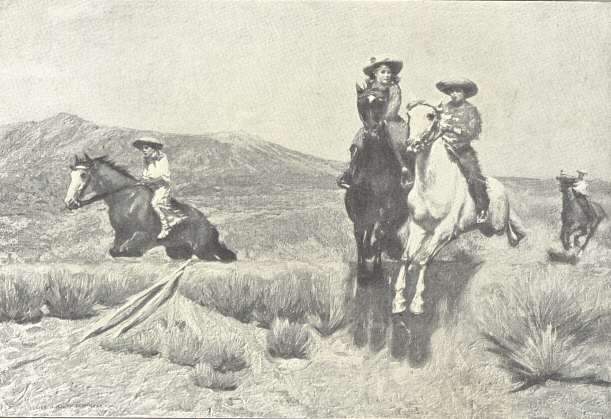
“I will tell a plain tale, calmly, without excitement,without eloquence. When she had been here four or fiveweeks she was already erudite in military things, and they madeher an officer—a double officer. She rode the drillevery day, like any soldier; and she could take the bugle anddirect the evolutions herself. Then, on a day, there was agrand race, for prizes—none to enter but thechildren. Seventeen children entered, and she was theyoungest. Three girls, fourteen boys—good ridersall. It was a steeplechase, with four hurdles, all prettyhigh. The first prize was a most cunning half-grown silverbugle, and mighty pretty, with red silk cord and tassels.Buffalo Bill was very anxious; for he had taught her to ride, andhe did most dearly want her to win that race, for the glory ofit. So he wanted her to ride me, but she wouldn’t;and she reproached him, and said it was unfair and unright, andtaking advantage; for what horse in this post or any other couldstand a chance against me? and she was very severe with him, andsaid, ‘You ought to be ashamed—you are proposing tome conduct unbecoming an officer and a gentleman.’ Sohe just tossed her up in the air about thirty feet and caught heras she came down, and said he was ashamed; and put up hishandkerchief and pretended to cry, which nearly broke her heart,and she petted him, and begged him to forgive her, and said shewould do anything in the world he could ask but that; but he saidhe ought to go hang himself, and he must, if he could geta rope; it was nothing but right he should, for he never, nevercould forgive himself; and then shebegan to cry, and theyboth sobbed, the way you could hear him a mile, and she clingingaround his neck and pleading, till at last he was comforted alittle, and gave his solemn promise he wouldn’t hanghimself till after the race; and wouldn’t do it at all ifshe won it, which made her happy, and she said she would win itor die in the saddle; so then everything was pleasant again andboth of them content. He can’t help playing jokes onher, he is so fond of her and she is so innocent andunsuspecting; and when she finds it out she cuffs him and is in afury, but presently forgives him because it’s him; andmaybe the very next day she’s caught with another joke; yousee she can’t learn any better, because she hasn’tany deceit in her, and that kind aren’t ever expecting itin another person.
“It was a grand race. The whole post was there,and there was such another whooping and shouting when theseventeen kids came flying down the turf and sailing over thehurdles—oh, beautiful to see! Half-way down, it waskind of neck and neck, and anybody’s race andnobody’s. Then, what should happen but a cow stepsout and puts her head down to munch grass, with her broadside tothe battalion, and they a-coming like the wind; they split apartto flank her, but she?—why, she drove the spurs homeand soared over that cow like a bird! and on she went, andcleared the last hurdle solitary and alone, the army lettingloose the grand yell, and she skipped from the horse the same asif he had been standing still, and made her bow, and everybodycrowded around to congratulate, and they gave her the bugle, andshe put it to her lips and blew ‘boots and saddles’to see how it would go, and BB was as proud as you can’tthink! And he said, ‘Take Soldier Boy, anddon’t pass him back till I ask for him!’ and I cantell you he wouldn’t have said that to any other person onthis planet. That was two months and more ago, and nobodyhas been on my back since but the Corporal-General SeventhCavalry and Flag-Lieutenant of the Ninth Dragoons,U.S.A.,—on whom be peace!”
“Amen. I listen—tell me more.”
“She set to work and organized the Sixteen, and calledit the First Battalion Rocky Mountain Rangers, U.S.A., and shewanted to be bugler, but they elected her Lieutenant-General andBugler. So she ranks her uncle the commandant, who is onlya Brigadier. And doesn’t she train those littlepeople! Ask the Indians, ask the traders, ask the soldiers;they’ll tell you. She has been at it from the firstday. Every morning they go clattering down into the plain,and there she sits on my back with her bugle at her mouth andsounds the orders and puts them through the evolutions for anhour or more; and it is too beautiful for anything to see thoseponies dissolve from one formation into another, and waltz about,and break, and scatter, and form again, always moving, alwaysgraceful, now trotting, now galloping, and so on, sometimes nearby, sometimes in the distance, all just like a state ball, youknow, and sometimes she can’t hold herself any longer, butsounds the ‘charge,’ and turns me loose! and you cantake my word for it, if the battalion hasn’t too much of astart we catch up and go over the breastworks with the frontline.
“Yes, they are soldiers, those little people; andhealthy, too, not ailing any more, the way they used to besometimes. It’s because of her drill.She’s got a fort, now—Fort Fanny Marsh.Major-General Tommy Drake planned it out, and the Seventh andDragoons built it. Tommy is the Colonel’s son, and isfifteen and the oldest in the Battalion; Fanny Marsh isBrigadier-General, and is next oldest—over thirteen.She is daughter of Captain Marsh, Company B, SeventhCavalry. Lieutenant-General Alison is the youngest byconsiderable; I think she is about nine and a half orthree-quarters. Her military rig, as Lieutenant-General,isn’t for business, it’s for dress parade, becausethe ladies made it. They say they got it out of the MiddleAges—out of a book—and it is all red and blue andwhite silks and satins and velvets; tights, trunks, sword,doublet with slashed sleeves, short cape, cap with just onefeather in it; I’ve heard them name these things; they gotthem out of the book; she’s dressed like a page, of oldtimes, they say. It’s the daintiest outfit that everwas—you will say so, when you see it. She’slovely in it—oh, just a dream! In some ways she isjust her age, but in others she’s as old as her uncle, Ithink. She is very learned. She teaches her uncle hisbook. I have seen her sitting by with the book and recitingto him what is in it, so that he can learn to do it himself.
“Every Saturday she hires little Injuns to garrison herfort; then she lays siege to it, and makes military approaches bymake-believe trenches in make-believe night, and finally atmake-believe dawn she draws her sword and sounds the assault andtakes it by storm. It is for practice. And she hasinvented a bugle-call all by herself, out of her own head, andit’s a stirring one, and the prettiest in theservice. It’s to call me—it’snever used for anything else. She taught it to me, and toldme what it says: ‘It is I,Soldier—come!’ and when those thrilling notescome floating down the distance I hear them without fail, even ifI am two miles away; and then—oh, then you should see myheels get down to business!
“And she has taught me how to say good-morning andgood-night to her, which is by lifting my right hoof for her toshake; and also how to say good-bye; I do that with my leftfoot—but only for practice, because there hasn’t beenany but make-believe good-byeing yet, and I hope therewon’t ever be. It would make me cry if I ever had toput up my left foot in earnest. She has taught me how tosalute, and I can do it as well as a soldier. I bow my headlow, and lay my right hoof against my cheek. She taught methat because I got into disgrace once, through ignorance. Iam privileged, because I am known to be honorable andtrustworthy, and because I have a distinguished record in theservice; so they don’t hobble me nor tie me to stakes orshut me tight in stables, but let me wander around to suitmyself. Well, trooping the colors is a very solemnceremony, and everybody must stand uncovered when the flag goesby, the commandant and all; and once I was there, and ignorantlywalked across right in front of the band, which was an awfuldisgrace: Ah, the Lieutenant-General was so ashamed, and sodistressed that I should have done such a thing before all theworld, that she couldn’t keep the tears back; and then shetaught me the salute, so that if I ever did any other unmilitaryact through ignorance I could do my salute and she believedeverybody would think it was apology enough and would not pressthe matter. It is very nice and distinguished; no otherhorse can do it; often the men salute me, and I return it.I am privileged to be present when the Rocky Mountain Rangerstroop the colors and I stand solemn, like the children, and Isalute when the flag goes by. Of course when she goes toher fort her sentries sing out ‘Turn out the guard!’and then . . . do you catch that refreshing early-morning whifffrom the mountain-pines and the wild flowers? The night isfar spent; we’ll hear the bugles before long. Dorcas,the black woman, is very good and nice; she takes care of theLieutenant-General, and is Brigadier-General Alison’smother, which makes her mother-in-law to theLieutenant-General. That is what Shekels says. Atleast it is what I think he says, though I never can understandhim quite clearly. He—”
“Who is Shekels?”
“The Seventh Cavalry dog. I mean, if he isa dog. His father was a coyote and his mother was awild-cat. It doesn’t really make a dog out of him,does it?”
“Not a real dog, I should think. Only a kind of ageneral dog, at most, I reckon. Though this is a matter ofichthyology, I suppose; and if it is, it is out of my depth, andso my opinion is not valuable, and I don’t claim muchconsideration for it.”
“It isn’t ichthyology; it is dogmatics, which isstill more difficult and tangled up. Dogmatics alwaysare.”
“Dogmatics is quite beyond me, quite; so I am notcompeting. But on general principles it is my opinion thata colt out of a coyote and a wild-cat is no square dog, butdoubtful. That is my hand, and I stand pat.”
“Well, it is as far as I can go myself, and be fair andconscientious. I have always regarded him as a doubtfuldog, and so has Potter. Potter is the great Dane.Potter says he is no dog, and not even poultry—though I donot go quite so far as that.
“And I wouldn’t, myself. Poultry is one ofthose things which no person can get to the bottom of, there isso much of it and such variety. It is just wings, andwings, and wings, till you are weary: turkeys, and geese, andbats, and butterflies, and angels, and grasshoppers, andflying-fish, and—well, there is really no end to the tribe;it gives me the heaves just to think of it. But this onehasn’t any wings, has he?”
“No.”
“Well, then, in my belief he is more likely to be dogthan poultry. I have not heard of poultry that hadn’twings. Wings is the signof poultry; it is what youtell poultry by. Look at the mosquito.”
“What do you reckon he is, then? He must besomething.”
“Why, he could be a reptile; anything that hasn’twings is a reptile.”
“Who told you that?”
“Nobody told me, but I overheard it.”
“Where did you overhear it?”
“Years ago. I was with the Philadelphia Instituteexpedition in the Bad Lands under Professor Cope, huntingmastodon bones, and I overheard him say, his own self, that anyplantigrade circumflex vertebrate bacterium that hadn’twings and was uncertain was a reptile. Well, then, has thisdog any wings? No. Is he a plantigrade circumflexvertebrate bacterium? Maybe so, maybe not; but without everhaving seen him, and judging only by his illegal and spectacularparentage, I will bet the odds of a bale of hay to a bran mashthat he looks it. Finally, is he uncertain? That isthe point—is he uncertain? I will leave it to you ifyou have ever heard of a more uncertainer dog than what this oneis?”
“No, I never have.”
“Well, then, he’s a reptile. That’ssettled.”
“Why, look here, whatsyourname—”
“Last alias, Mongrel.”
“A good one, too. I was going to say, you arebetter educated than you have been pretending to be. I likecultured society, and I shall cultivate your acquaintance.Now as to Shekels, whenever you want to know about any privatething that is going on at this post or in White Cloud’scamp or Thunder-Bird’s, he can tell you; and if you makefriends with him he’ll be glad to, for he is a born gossip,and picks up all the tittle-tattle. Being the whole SeventhCavalry’s reptile, he doesn’t belong to anybody inparticular, and hasn’t any military duties; so he comes andgoes as he pleases, and is popular with all the house cats andother authentic sources of private information. Heunderstands all the languages, and talks them all, too.With an accent like gritting your teeth, it is true, and with agrammar that is no improvement on blasphemy—still, withpractice you get at the meat of what he says, and it serves. . .Hark! That’s the reveille. . . .
 [80]
[80]“Faint and far, but isn’t it clear, isn’t itsweet? There’s no music like the bugle to stir theblood, in the still solemnity of the morning twilight, with thedim plain stretching away to nothing and the spectral mountainsslumbering against the sky. You’ll hear another notein a minute—faint and far and clear, like the other one,and sweeter still, you’ll notice. Wait . . .listen. There it goes! It says, ‘It isI, Soldier—come!’ . . .
![Soldier Boy’s Bugle Call [music score]](https://www.gutenberg.org/cache/epub/1086/images/p81s.jpg "Soldier Boy’s Bugle Call [music score]")
. . . Now then, watch me leave a blue streakbehind!”
VII
SOLDIER BOY AND SHEKELS
“Did you do as I toldyou? Did you look up the Mexican Plug?”
“Yes, I made his acquaintance before night and got hisfriendship.”
“I liked him. Did you?”
“Not at first. He took me for a reptile, and ittroubled me, because I didn’t know whether it was acompliment or not. I couldn’t ask him, because itwould look ignorant. So I didn’t say anything, andsoon liked him very well indeed. Was it a compliment, doyou think?”
“Yes, that is what it was. They are very rare, thereptiles; very few left, now-a-days.”
“Is that so? What is a reptile?”
“It is a plantigrade circumflex vertebrate bacteriumthat hasn’t any wings and is uncertain.”
“Well, it—it sounds fine, it surelydoes.”
“And it isfine. You may be thankful youare one.”
“I am. It seems wonderfully grand and elegant fora person that is so humble as I am; but I am thankful, I amindeed, and will try to live up to it. It is hard toremember. Will you say it again, please, and say itslow?”
“Plantigrade circumflex vertebrate bacterium thathasn’t any wings and is uncertain.”
“It is beautiful, anybody must grant it; beautiful, andof a noble sound. I hope it will not make me proud andstuck-up—I should not like to be that. It is muchmore distinguished and honorable to be a reptile than a dog,don’t you think, Soldier?”
“Why, there’s no comparison. It is awfullyaristocratic. Often a duke is called a reptile; it is setdown so, in history.”
“Isn’t that grand! Potter wouldn’tever associate with me, but I reckon he’ll be glad to whenhe finds out what I am.”
“You can depend upon it.”
“I will thank Mongrel for this. He is a very good sort,for a Mexican Plug. Don’t you think he is?”
“It is my opinion of him; and as for his birth, hecannot help that. We cannot all be reptiles, we cannot allbe fossils; we have to take what comes and be thankful it is noworse. It is the true philosophy.”
“For those others?”
“Stick to the subject, please. Did it turn outthat my suspicions were right?”
“Yes, perfectly right. Mongrel has heard themplanning. They are after BB’s life, for running themout of Medicine Bow and taking their stolen horses away fromthem.”
“Well, they’ll get him yet, for sure.”
“Not if he keeps a sharp look-out.”
“Hekeep a sharp lookout! He never does; hedespises them, and all their kind. His life is always beingthreatened, and so it has come to be monotonous.”
“Does he know they are here?”
“Oh yes, he knows it. He is always the earliest toknow who comes and who goes. But he cares nothing for themand their threats; he only laughs when people warn him.They’ll shoot him from behind a tree the first heknows. Did Mongrel tell you their plans?”
“Yes. They have found out that he starts for FortClayton day after to-morrow, with one of his scouts; so they willleave to-morrow, letting on to go south, but they will fetcharound north all in good time.”
“Shekels, I don’t like the look of it.”
VIII
THE SCOUT-START. BB ANDLIEUTENANT-GENERAL ALISON
BB (saluting). “Good! handsomelydone! The Seventh couldn’t beat it! You docertainly handle your Rangers like an expert, General. Andwhere are you bound?”
“Four miles on the trail to Fort Clayton.”
“Glad am I, dear! What’s the idea ofit?”
“Guard of honor for you and Thorndike.”
“Bless—your—heart! I’drather have it from you than from the Commander-in-Chief of thearmies of the United States, you incomparable littlesoldier!—and I don’t need to take any oath to that,for you to believe it.”
“I thoughtyou’d like it, BB.”
“Likeit? Well, I should say so! Nowthen—all ready—sound the advance, and away wego!”
IX
SOLDIER BOY AND SHEKELS AGAIN
“Well, this is the way ithappened. We did the escort duty; then we came back andstruck for the plain and put the Rangers through a rousingdrill—oh, for hours! Then we sent them home underBrigadier-General Fanny Marsh; then the Lieutenant-General and Iwent off on a gallop over the plains for about three hours, andwere lazying along home in the middle of the afternoon, when wemet Jimmy Slade, the drummer-boy, and he saluted and asked theLieutenant-General if she had heard the news, and she said no,and he said:
“‘Buffalo Bill has been ambushed and badly shotthis side of Clayton, and Thorndike the scout, too; Billcouldn’t travel, but Thorndike could, and he brought thenews, and Sergeant Wilkes and six men of Company B are gone, twohours ago, hotfoot, to get Bill. And theysay—’
“‘Go!’ she shouts to me—and Iwent.”
“Fast?”
“Don’t ask foolish questions. It was anawful pace. For four hours nothing happened, and not a wordsaid, except that now and then she said, ‘Keep it up, Boy,keep it up, sweetheart; we’ll save him!’ I keptit up. Well, when the dark shut down, in the rugged hills,that poor little chap had been tearing around in the saddle allday, and I noticed by the slack knee-pressure that she was tiredand tottery, and I got dreadfully afraid; but every time I triedto slow down and let her go to sleep, so I could stop, shehurried me up again; and so, sure enough, at last over shewent!
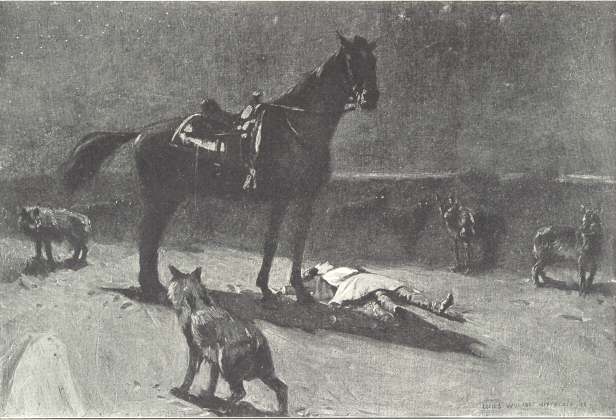
“Ah, that was a fix to be in I for she lay there anddidn’t stir, and what was I to do? I couldn’tleave her to fetch help, on account of the wolves. Therewas nothing to do but stand by. It was dreadful. Iwas afraid she was killed, poor little thing! But shewasn’t. She came to, by-and-by, and said, ‘Kissme, Soldier,’ and those were blessed words. I kissedher—often; I am used to that, and we like it. But shedidn’t get up, and I was worried. She fondled my nosewith her hand, and talked to me, and called me endearingnames—which is her way—but she caressed with the samehand all the time. The other arm was broken, you see, but Ididn’t know it, and she didn’t mention it. Shedidn’t want to distress me, you know.
“Soon the big gray wolves came, and hung around, and youcould hear them snarl, and snap at each other, but youcouldn’t see anything of them except their eyes, whichshone in the dark like sparks and stars. TheLieutenant-General said, ‘If I had the Rocky MountainRangers here, we would make those creatures climb atree.’ Then she made believe that the Rangers were inhearing, and put up her bugle and blew the‘assembly’; and then, ‘boots andsaddles’; then the ‘trot’;‘gallop’; ‘charge!’ Then she blewthe ‘retreat,’ and said, ‘That’s for you,you rebels; the Rangers don’t ever retreat!’
“The music frightened them away, but they were hungry,and kept coming back. And of course they got bolder andbolder, which is their way. It went on for an hour, thenthe tired child went to sleep, and it was pitiful to hear hermoan and nestle, and I couldn’t do anything for her.All the time I was laying for the wolves. They are in myline; I have had experience. At last the boldest oneventured within my lines, and I landed him among his friends withsome of his skull still on him, and they did the rest. Inthe next hour I got a couple more, and they went the way of thefirst one, down the throats of the detachment. Thatsatisfied the survivors, and they went away and left us inpeace.
“We hadn’t any more adventures, though I keptawake all night and was ready. From midnight on the childgot very restless, and out of her head, and moaned, and said,‘Water, water—thirsty’; and now and then,‘Kiss me, Soldier’; and sometimes she was in her fortand giving orders to her garrison; and once she was in Spain, andthought her mother was with her. People say a horsecan’t cry; but they don’t know, because we cryinside.
“It was an hour after sunup that I heard the boyscoming, and recognized the hoof-beats of Pomp and Cæsar andJerry, old mates of mine; and a welcomer sound therecouldn’t ever be.
Buffalo Bill was in a horse-litter, with his leg broken by abullet, and Mongrel and Blake Haskins’s horse were doingthe work. Buffalo Bill and Thorndike had lolled both ofthose toughs.
“When they got to us, and Buffalo Bill saw the childlying there so white, he said, ‘My God!’ and thesound of his voice brought her to herself, and she gave a littlecry of pleasure and struggled to get up, but couldn’t, andthe soldiers gathered her up like the tenderest women, and theireyes were wet and they were not ashamed, when they saw her armdangling; and so were Buffalo Bill’s, and when they laidher in his arms he said, ‘My darling, how does thiscome?’ and she said, ‘We came to save you, but I wastired, and couldn’t keep awake, and fell off and hurtmyself, and couldn’t get on again.’ ‘Youcame to save me, you dear little rat? It was too lovely ofyou!’ ‘Yes, and Soldier stood by me, which youknow he would, and protected me from the wolves; and if he got achance he kicked the life out of some of them—for you knowhe would, BB.’ The sergeant said, ‘He laid outthree of them, sir, and here’s the bones to show forit.’ ‘He’s a grand horse,’ said BB;‘he’s the grandest horse that ever was! and has savedyour life, Lieutenant-General Alison, and shall protect it therest of his life—he’s yours for a kiss!’He got it, along with a passion of delight, and he said,‘You are feeling better now, little Spaniard—do youthink you could blow the advance?’ She put up thebugle to do it, but he said wait a minute first. Then heand the sergeant set her arm and put it in splints, she wincingbut not whimpering; then we took up the march for home, andthat’s the end of the tale; and I’m her horse.Isn’t she a brick, Shekels?
“Brick? She’s more than a brick, more than athousand bricks—she’s a reptile!”
“It’s a compliment out of your heart,Shekels. God bless you for it!”
X
GENERAL ALISON AND DORCAS
“Too much company for her,Marse Tom. Betwixt you, and Shekels, the Colonel’swife, and the Cid—”
“The Cid? Oh, I remember—theraven.”
“—and Mrs. Captain Marsh and Famine and Pestilencethe baby coyotes, and Sour-Mash and her pups, andSardanapalus and her kittens—hang these names she gives thecreatures, they warp my jaw—and Potter: you—allsitting around in the house, and Soldier Boy at the window theentire time, it’s a wonder to me she comes along as well asshe does. She—”
“You want her all to yourself, you stingy oldthing!”
“Marse Tom, you know better. It’s too muchcompany. And then the idea of her receiving reports all thetime from her officers, and acting upon them, and giving orders,the same as if she was well! It ain’t good for her,and the surgeon don’t like it, and tried to persuade hernot to and couldn’t; and when he orderedher, shewas that outraged and indignant, and was very severe on him, andaccused him of insubordination, and said it didn’t becomehim to give orders to an officer of her rank. Well, he sawhe had excited her more and done more harm than all the rest puttogether, so he was vexed at himself and wished he had keptstill. Doctors don’tknow much, andthat’s a fact. She’s too much interested inthings—she ought to rest more. She’s all thetime sending messages to BB, and to soldiers and Injuns andwhatnot, and to the animals.”
“To the animals?”
“Yes, sir.”
“Who carries them?”
“Sometimes Potter, but mostly it’sShekels.”
“Now come! who can find fault with such prettymake-believe as that?”
“But it ain’t make-believe, Marse Tom. Shedoes send them.”
“Yes, I don’t doubt that part of it.”
“Do you doubt they get them, sir?”
“Certainly. Don’t you?”
“No, sir. Animals talk to one another. Iknow it perfectly well, Marse Tom, and I ain’t saying it byguess.”
“What a curious superstition!”
“It ain’t a superstition, Marse Tom. Look atthat Shekels—look at him, now. Is helistening, or ain’t he? Nowyou see!he’s turned his head away. It’s because he wascaught—caught in the act. I’ll askyou—could a Christian look any more ashamed than what helooks now?—lay down! You see? he was going tosneak out. Don’t tell me, Marse Tom! Ifanimals don’t talk, I miss myguess. AndShekels is the worst. He goes and tells the animalseverything that happens in the officers’ quarters; and ifhe’s short of facts, he invents them. He hasn’tany more principle than a blue jay; and as for morals, he’sempty. Look at him now; look at him grovel. He knowswhat I am saying, and he knows it’s the truth. Yousee, yourself, that he can feel shame; it’s the only virtuehe’s got. It’s wonderful how they find outeverything that’s going on—the animals.They—”
“Do you really believe they do, Dorcas?”
“I don’t only just believe it, Marse Tom, I knowit. Day before yesterday they knew something was going tohappen. They were that excited, and whispering aroundtogether; why, anybody could see that they— But my! I mustget back to her, and I haven’t got to my errandyet.”
“What is it, Dorcas?”
“Well, it’s two or three things. One is, thedoctor don’t salute when he comes . . . Now, Marse Tom, itain’t anything to laugh at, and so—”
“Well, then, forgive me; I didn’t mean tolaugh—I got caught unprepared.”
“You see, she don’t want to hurt thedoctor’s feelings, so she don’t say anything to himabout it; but she is always polite, herself, and it hurts thatkind for people to be rude to them.”
“I’ll have that doctor hanged.”
“Marse Tom, she don’t wanthimhanged. She—”
“Well, then, I’ll have him boiled inoil.”
“But she don’t wanthim boiled.I—”
“Oh, very well, very well, I only want to please her;I’ll have him skinned.”
“Why, shedon’t want him skinned; it wouldbreak her heart. Now—”
“Woman, this is perfectly unreasonable. What inthe nation doesshe want?”
“Marse Tom, if you would only be a little patient, andnot fly off the handle at the least little thing. Why, sheonly wants you to speak to him.”
“Speak to him! Well, upon my word! All thisunseemly rage and row about such a—a— Dorcas, I neversaw you carry on like this before. You have alarmed thesentry; he thinks I am being assassinated; he thinksthere’s a mutiny, a revolt, an insurrection;he—”
“Marse Tom, you are just putting on; you know itperfectly well; I don’t know what makes you act likethat—but you always did, even when you was little, and youcan’t get over it, I reckon. Are you over it now,Marse Tom?”
“Oh, well, yes; but it would try anybody to be doing thebest he could, offering every kindness he could think of, only tohave it rejected with contumely and . . . Oh, well, let it go;it’s no matter—I’ll talk to the doctor.Is that satisfactory, or are you going to break outagain?”
“Yes, sir, it is; and it’s only right to talk tohim, too, because it’s just as she says; she’s tryingto keep up discipline in the Rangers, and this insubordination ofhis is a bad example for them—now ain’t it so, MarseTom?”
“Well, there isreason in it, I can’t denyit; so I will speak to him, though at bottom I think hangingwould be more lasting. What is the rest of your errand,Dorcas?”
“Of course her room is Ranger headquarters now, MarseTom, while she’s sick. Well, soldiers of the cavalryand the dragoons that are off duty come and get her sentries tolet them relieve them and serve in their place. It’sonly out of affection, sir, and because they know military honorsplease her, and please the children too, for her sake; and theydon’t bring their muskets; and so—”
“I’ve noticed them there, but didn’t twigthe idea. They are standing guard, are they?”
“Yes, sir, and she is afraid you will reprove them andhurt their feelings, if you see them there; so she begs,if—if you don’t mind coming in the backway—”
“Bear me up, Dorcas; don’t let mefaint.”
“There—sit up and behave, Marse Tom. You arenot going to faint; you are only pretending—you used to actjust so when you was little; it does seem a long time for you toget grown up.”
“Dorcas, the way the child is progressing, I shall beout of my job before long—she’ll have the whole postin her hands. I must make a stand, I must not go downwithout a struggle. These encroachments. . . . Dorcas, whatdo you think she will think of next?”
“Marse Tom, she don’t mean any harm.”
“Are you sure of it?”
“Yes, Marse Tom.”
“You feel sure she has no ulterior designs?”
“I don’t know what that is, Marse Tom, but I knowshe hasn’t.”
“Very well, then, for the present I am satisfied.What else have you come about?”
“I reckon I better tell you the whole thing first, MarseTom, then tell you what she wants. There’s been anemeute, as she calls it. It was before she got back withBB. The officer of the day reported it to her thismorning. It happened at her fort. There was a fussbetwixt Major-General Tommy Drake and Lieutenant-Colonel AgnesFrisbie, and he snatched her doll away, which is made of whitekid stuffed with sawdust, and tore every rag of its clothes off,right before them all, and is under arrest, and the charge isconduct un—”
“Yes, I know—conduct unbecoming an officer and agentleman—a plain case, too, it seems to me. This isa serious matter. Well, what is her pleasure?”
“Well, Marse Tom, she has summoned a court-martial, butthe doctor don’t think she is well enough to preside overit, and she says there ain’t anybody competent but her,because there’s a major-general concerned; and soshe—she—well, she says, would you preside over it forher? . . . Marse Tom, situp! You ain’t anymore going to faint than Shekels is.”
“Look here, Dorcas, go along back, and be tactful.Be persuasive; don’t fret her; tell her it’s allright, the matter is in my hands, but it isn’t good form tohurry so grave a matter as this. Explain to her that wehave to go by precedents, and that I believe this one to benew. In fact, you can say I know that nothing just like ithas happened in our army, therefore I must be guided by Europeanprecedents, and must go cautiously and examine themcarefully. Tell her not to be impatient, it will take meseveral days, but it will all come out right, and I will comeover and report progress as I go along. Do you get theidea, Dorcas?”
“I don’t know as I do, sir.”
“Well, it’s this. You see, it won’tever do for me, a brigadier in the regular army, to preside overthat infant court-martial—there isn’t any precedentfor it, don’t you see. Very well. I will go onexamining authorities and reporting progress until she is wellenough to get me out of this scrape by presiding herself.Do you get it now?”
“Oh, yes, sir, I get it, and it’s good, I’llgo and fix it with her. Lay down! and stay where youare.”
“Why, what harm is he doing?”
“Oh, it ain’t any harm, but it just vexes me tosee him act so.”
“What was he doing?”
“Can’t you see, and him in such a sweat? Hewas starting out to spread it all over the post. NowI reckon you won’t deny, any more, that they go and telleverything they hear, now that you’ve seen it withyo’ own eyes.”
“Well, I don’t like to acknowledge it, Dorcas, butI don’t see how I can consistently stick to my doubts inthe face of such overwhelming proof as this dog isfurnishing.”
“There, now, you’ve got in yo’ right mind atlast! I wonder you can be so stubborn, Marse Tom. Butyou always was, even when you was little. I’m goingnow.”
“Look here; tell her that in view of the delay, it is myjudgment that she ought to enlarge the accused on hisparole.”
“Yes, sir, I’ll tell her. MarseTom?”
“Well?”
“She can’t get to Soldier Boy, and he stands thereall the time, down in the mouth and lonesome; and she says willyou shake hands with him and comfort him? Everybodydoes.”
“It’s a curious kind of lonesomeness; but, allright, I will.”
XI
SEVERAL MONTHS LATER. ANTONIO ANDTHORNDIKE
“Thorndike, isn’t thatPlug you’re riding an asset of the scrap you and BuffaloBill had with the late Blake Haskins and his pal a few monthsback?”
“Yes, this is Mongrel—and not a half-bad horse,either.”
“I’ve noticed he keeps up his lickfirst-rate. Say—isn’t it a gaudymorning?”
“Right you are!”
“Thorndike, it’s Andalusian! and when that’ssaid, all’s said.”
“Andalusian andOregonian, Antonio! Put itthat way, and you have my vote. Being a native up there, Iknow. You being Andalusian-born—”
“Can speak with authority for that patch ofparadise? Well, I can. Like the Don! likeSancho! This is the correct Andalusian dawnnow—crisp, fresh, dewy, fragrant, pungent—”
“‘What though the spicy breezes
Blow soft o’er Ceylon’s isle—’
—gitup, you old cow! stumbling like that whenwe’ve just been praising you! out on a scout andcan’t live up to the honor any better than that?Antonio, how long have you been out here in the Plains and theRockies?”
“More than thirteen years.”
“It’s a long time. Don’t you ever gethomesick?”
“Not till now.”
“Why now?—after such a longcure.”
“These preparations of the retiring commandant’shave started it up.”
“Of course. It’s natural.”
“It keeps me thinking about Spain. I know theregion where the Seventh’s child’s aunt lives; I knowall the lovely country for miles around; I’ll betI’ve seen her aunt’s villa many a time; I’llbet I’ve been in it in those pleasant old times when I wasa Spanish gentleman.”
“They say the child is wild to see Spain.”
“It’s so; I know it from what I hear.”
“Haven’t you talked with her about it?”
“No. I’ve avoided it. I should soon beas wild as she is. That would not becomfortable.”
“I wish I was going, Antonio. There’s twothings I’d give a lot to see. One’s arailroad.”
“She’ll see one when she strikesMissouri.”
“The other’s a bull-fight.”
“I’ve seen lots of them; I wish I could seeanother.”
“I don’t know anything about it, except in amixed-up, foggy way, Antonio, but I know enough to knowit’s grand sport.”
“The grandest in the world! There’s no othersport that begins with it. I’ll tell you whatI’ve seen, then you can judge. It was my first, andit’s as vivid to me now as it was when I saw it. Itwas a Sunday afternoon, and beautiful weather, and my uncle, thepriest, took me as a reward for being a good boy and because ofmy own accord and without anybody asking me I had bankrupted mysavings-box and given the money to a mission that was civilizingthe Chinese and sweetening their lives and softening their heartswith the gentle teachings of our religion, and I wish you couldhave seen what we saw that day, Thorndike.
“The amphitheatre was packed, from the bull-ring to thehighest row—twelve thousand people in one circling mass,one slanting, solid mass—royalties, nobles, clergy, ladies,gentlemen, state officials, generals, admirals, soldiers,sailors, lawyers, thieves, merchants, brokers, cooks, housemaids,scullery-maids, doubtful women, dudes, gamblers, beggars,loafers, tramps, American ladies, gentlemen, preachers, Englishladies, gentlemen, preachers, German ditto, French ditto, and soon and so on, all the world represented: Spaniards to admire andpraise, foreigners to enjoy and go home and findfault—there they were, one solid, sloping, circling sweepof rippling and flashing color under the downpour of the summersun—just a garden, a gaudy, gorgeous flower-garden!Children munching oranges, six thousand fans fluttering andglimmering, everybody happy, everybody chatting gayly with theirintimates, lovely girl-faces smiling recognition and salutationto other lovely girl-faces, gray old ladies and gentlemen dealingin the like exchanges with each other—ah, such a picture ofcheery contentment and glad anticipation! not a mean spirit, nora sordid soul, nor a sad heart there—ah, Thorndike, I wishI could see it again.
“Suddenly, the martial note of a bugle cleaves the humand murmur—clear the ring!
“They clear it. The great gate is flung open, andthe procession marches in, splendidly costumed and glittering:the marshals of the day, then the picadores on horseback, thenthe matadores on foot, each surrounded by his quadrille ofchulos. They march to the box of the city fathers,and formally salute. The key is thrown, the bull-gate isunlocked. Another bugle blast—the gate flies open,the bull plunges in, furious, trembling, blinking in the blindinglight, and stands there, a magnificent creature, centre of thosemultitudinous and admiring eyes, brave, ready for battle, hisattitude a challenge. He sees his enemy: horsemen sittingmotionless, with long spears in rest, upon blindfoldedbroken-down nags, lean and starved, fit only for sport andsacrifice, then the carrion-heap.
“The bull makes a rush, with murder in his eye, but apicador meets him with a spear-thrust in the shoulder. Heflinches with the pain, and the picador skips out ofdanger. A burst of applause for the picador, hisses for thebull. Some shout ‘Cow!’ at the bull, and callhim offensive names. But he is not listening to them, he isthere for business; he is not minding the cloak-bearers that comefluttering around to confuse him; he chases this way, he chasesthat way, and hither and yon, scattering the nimble banderillosin every direction like a spray, and receiving their maddeningdarts in his neck as they dodge and fly—oh, but it’sa lively spectacle, and brings down the house! Ah, youshould hear the thundering roar that goes up when the game is atits wildest and brilliant things are done!
“Oh, that first bull, that day, was great! Fromthe moment the spirit of war rose to flood-tide in him and he gotdown to his work, he began to do wonders. He tore his waythrough his persecutors, flinging one of them clear over theparapet; he bowled a horse and his rider down, and plungedstraight for the next, got home with his horns, wounding bothhorse and man; on again, here and there and this way and that;and one after another he tore the bowels out of two horses sothat they gushed to the ground, and ripped a third one so badlythat although they rushed him to cover and shoved his bowels backand stuffed the rents with tow and rode him against the bullagain, he couldn’t make the trip; he tried to gallop, underthe spur, but soon reeled and tottered and fell, all in aheap. For a while, that bull-ring was the most thrillingand glorious and inspiring sight that ever was seen. Thebull absolutely cleared it, and stood there alone! monarch of theplace. The people went mad for pride in him, and joy anddelight, and you couldn’t hear yourself think, for the roarand boom and crash of applause.”
“Antonio, it carries me clear out of myself just to hearyou tell it; it must have been perfectly splendid. If Ilive, I’ll see a bull-fight yet before I die. Didthey kill him?”
“Oh yes; that is what the bull is for. They tiredhim out, and got him at last. He kept rushing the matador,who always slipped smartly and gracefully aside in time, waitingfor a sure chance; and at last it came; the bull made a deadlyplunge for him—was avoided neatly, and as he sped by, thelong sword glided silently into him, between left shoulder andspine—in and in, to the hilt. He crumpled down,dying.”
“Ah, Antonio, it isthe noblest sport that everwas. I would give a year of my life to see it. Is thebull always killed?”
“Yes. Sometimes a bull is timid, finding himselfin so strange a place, and he stands trembling, or tries toretreat. Then everybody despises him for his cowardice andwants him punished and made ridiculous; so they hough him frombehind, and it is the funniest thing in the world to see himhobbling around on his severed legs; the whole vast house goesinto hurricanes of laughter over it; I have laughed till thetears ran down my cheeks to see it. When he has furnishedall the sport he can, he is not any longer useful, and iskilled.”
“Well, it is perfectly grand, Antonio, perfectlybeautiful. Burning a nigger don’t begin.”
XII
MONGREL AND THE OTHER HORSE
“Sage-Brush, you have beenlistening?”
“Yes.”
“Isn’t it strange?”
“Well, no, Mongrel, I don’t know that itis.”
“Why don’t you?”
“I’ve seen a good many human beings in mytime. They are created as they are; they cannot helpit. They are only brutal because that is their make; bruteswould be brutal if it was theirmake.”
“To me, Sage-Brush, man is most strange andunaccountable. Why should he treat dumb animals that waywhen they are not doing any harm?”
“Man is not always like that, Mongrel; he is kind enoughwhen he is not excited by religion.”
“Is the bull-fight a religious service?”
“I think so. I have heard so. It is held onSunday.”
(A reflective pause, lasting somemoments.) Then:
“When we die, Sage-Brush, do we go to heaven and dwellwith man?”
“My father thought not. He believed we do not haveto go there unless we deserve it.”
Part II
IN SPAIN
XIII
GENERAL ALISON TO HIS MOTHER
It was a prodigious trip, butdelightful, of course, through the Rockies and the Black Hillsand the mighty sweep of the Great Plains to civilization and theMissouri border—where the railroading began and thedelightfulness ended. But no one is the worse for thejourney; certainly not Cathy, nor Dorcas, nor Soldier Boy; and asfor me, I am not complaining.
Spain is all that Cathy had pictured it—and more, shesays. She is in a fury of delight, the maddest littleanimal that ever was, and all for joy. She thinks sheremembers Spain, but that is not very likely, I suppose.The two—Mercedes and Cathy—devour each other.It is a rapture of love, and beautiful to see. It isSpanish; that describes it. Will this be a short visit?
No. It will be permanent. Cathy has elected toabide with Spain and her aunt. Dorcas says she (Dorcas)foresaw that this would happen; and also says that she wanted itto happen, and says the child’s own country is the rightplace for her, and that she ought not to have been sent to me, Iought to have gone to her. I thought it insane to takeSoldier Boy to Spain, but it was well that I yielded toCathy’s pleadings; if he had been left behind, half of herheart would have remained with him, and she would not have beencontented. As it is, everything has fallen out for thebest, and we are all satisfied and comfortable. It may bethat Dorcas and I will see America again some day; but also it isa case of maybe not.
We left the post in the early morning. It was anaffecting time. The women cried over Cathy, so did eventhose stern warriors, the Rocky Mountain Rangers; Shekels wasthere, and the Cid, and Sardanapalus, and Potter, and Mongrel,and Sour-Mash, Famine, and Pestilence, and Cathy kissed them alland wept; details of the several arms of the garrison werepresent to represent the rest, and say good-bye and God bless youfor all the soldiery; and there was a special squad from theSeventh, with the oldest veteran at its head, to speed theSeventh’s Child with grand honors and impressiveceremonies; and the veteran had a touching speech by heart, andput up his hand in salute and tried to say it, but his lipstrembled and his voice broke, but Cathy bent down from the saddleand kissed him on the mouth and turned his defeat to victory, anda cheer went up.
The next act closed the ceremonies, and was a movingsurprise. It may be that you have discovered, before this,that the rigors of military law and custom melt insensibly awayand disappear when a soldier or a regiment or the garrison wantsto do something that will please Cathy. The bands conceivedthe idea of stirring her soldierly heart with a farewell whichwould remain in her memory always, beautiful and unfading, andbring back the past and its love for her whenever she shouldthink of it; so they got their project placed before GeneralBurnaby, my successor, who is Cathy’s newest slave, and inspite of poverty of precedents they got his permission. Thebands knew the child’s favorite military airs. Bythis hint you know what is coming, but Cathy didn’t.She was asked to sound the “reveille,” which shedid.
![Reveille [music score]](https://www.gutenberg.org/cache/epub/1086/images/p138s.jpg "Reveille [music score]")
With the last note the bands burst out with a crash: and wokethe mountains with the “Star-Spangled Banner” in away to make a body’s heart swell and thump and his hairrise! It was enough to break a person all up, to seeCathy’s radiant face shining out through her gladness andtears. By request she blew the “assembly,” now.. . .
![The Assembly [music score]](https://www.gutenberg.org/cache/epub/1086/images/p139as.jpg "The Assembly [music score]")
. . . Then the bands thundered in, with “Rally round theflag, boys, rally once again!” Next, she blew anothercall (“to the Standard”) . . .
![To the Standard [music score]](https://www.gutenberg.org/cache/epub/1086/images/p139bs.jpg "To the Standard [music score]")
. . . and the bands responded with “When we weremarching through Georgia.” Straightway she sounded“boots and saddles,” that thrilling and mostexpediting call. . . .
![Boots and Saddles [music score]](https://www.gutenberg.org/cache/epub/1086/images/p140s.jpg "Boots and Saddles [music score]")
and the bands could hardly hold in for the final note; thenthey turned their whole strength loose on “Tramp, tramp,tramp, the boys are marching,” and everybody’sexcitement rose to blood-heat.
Now an impressive pause—then the bugle sang “Taps”—translatable, this time,into “Good-bye, and God keep us all!” for taps is thesoldier’s nightly release from duty, and farewell:plaintive, sweet, pathetic, for the morning is never sure, forhim; always it is possible that he is hearing it for the lasttime. . . .
![Taps [music score]](https://www.gutenberg.org/cache/epub/1086/images/p141s.jpg "Taps [music score]")
. . . Then the bands turned their instruments towards Cathyand burst in with that rollicking frenzy of a tune, “Oh,we’ll all get blind drunk when Johnny comes marchinghome—yes, we’ll all get blind drunk when Johnny comesmarching home!” and followed it instantly with“Dixie,” that antidote for melancholy, merriest andgladdest of all military music on any side of the ocean—andthat was the end. And so—farewell!
I wish you could have been there to see it all, hear it all,and feel it: and get yourself blown away with the hurricane huzzathat swept the place as a finish.
When we rode away, our main body had already been on the roadan hour or two—I speak of our camp equipage; but wedidn’t move off alone: when Cathy blew the“advance” the Rangers cantered out in column offours, and gave us escort, and were joined by White Cloud andThunder-Bird in all their gaudy bravery, and by Buffalo Bill andfour subordinate scouts. Three miles away, in the Plains,the Lieutenant-General halted, sat her horse like a militarystatue, the bugle at her lips, and put the Rangers through theevolutions for half an hour; and finally, when she blew the“charge,” she led it herself. “Not forthe last time,” she said, and got a cheer, and we saidgood-bye all around, and faced eastward and rode away.
Postscript. A Day Later. Soldier Boywas stolen last night. Cathy is almost beside herself, andwe cannot comfort her. Mercedes and I are not much alarmedabout the horse, although this part of Spain is in something of aturmoil, politically, at present, and there is a good deal oflawlessness. In ordinary times the thief and the horsewould soon be captured. We shall have them before long, Ithink.
XIV
SOLDIER BOY—TO HIMSELF
It is five months. Or is itsix? My troubles have clouded my memory. I have beenall over this land, from end to end, and now I am back againsince day before yesterday, to that city which we passed through,that last day of our long journey, and which is near her countryhome. I am a tottering ruin and my eyes are dim, but Irecognized it. If she could see me she would know me andsound my call. I wish I could hear it once more; it wouldrevive me, it would bring back her face and the mountains and thefree life, and I would come—if I were dying I wouldcome! She would not know me, looking as I do, butshe would know me by my star. But she will never see me,for they do not let me out of this shabby stable—a foul andmiserable place, with most two wrecks like myself forcompany.
How many times have I changed hands? I think it istwelve times—I cannot remember; and each time it was down astep lower, and each time I got a harder master. They havebeen cruel, every one; they have worked me night and day indegraded employments, and beaten me; they have fed me ill, andsome days not at all. And so I am but bones, now, with arough and frowsy skin humped and cornered upon my shrunkenbody—that skin which was once so glossy, that skin whichshe loved to stroke with her hand. I was the pride of themountains and the Great Plains; now I am a scarecrow anddespised. These piteous wrecks that are my comrades heresay we have reached the bottom of the scale, the finalhumiliation; they say that when a horse is no longer worth theweeds and discarded rubbish they feed to him, they sell him tothe bull-ring for a glass of brandy, to make sport for the peopleand perish for their pleasure.
To die—that does not disturb me; we of the service nevercare for death. But if I could see her once more! if Icould hear her bugle sing again and say, “It is I,Soldier—come!”
XV
GENERAL ALISON TO MRS. DRAKE, THECOLONEL’S WIFE
To return, now, to where I was, andtell you the rest. We shall never know how she came to bethere; there is no way to account for it. She was alwayswatching for black and shiny and spirited horses—watching,hoping, despairing, hoping again; always giving chase andsounding her call, upon the meagrest chance of a response, andbreaking her heart over the disappointment; always inquiring,always interested in sales-stables and horse accumulations ingeneral. How she got there must remain a mystery.
At the point which I had reached in a preceding paragraph ofthis account, the situation was as follows: two horses lay dying;the bull had scattered his persecutors for the moment, and stoodraging, panting, pawing the dust in clouds over his back, whenthe man that had been wounded returned to the ring on a remount,a poor blindfolded wreck that yet had something ironicallymilitary about his bearing—and the next moment the bull hadripped him open and his bowls were dragging upon the ground: andthe bull was charging his swarm of pests again. Then camepealing through the air a bugle-call that froze myblood—“It is I,Soldier—come!” I turned; Cathy wasflying down through the massed people; she cleared the parapet ata bound, and sped towards that riderless horse, who staggeredforward towards the remembered sound; but his strength failed,and he fell at her feet, she lavishing kisses upon him andsobbing, the house rising with one impulse, and white withhorror! Before help could reach her the bull was backagain—
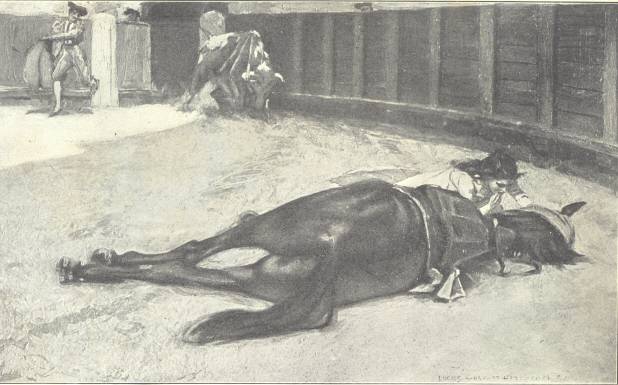
She was never conscious again in life. We bore her home,all mangled and drenched in blood, and knelt by her and listenedto her broken and wandering words, and prayed for her passingspirit, and there was no comfort—nor ever will be, Ithink. But she was happy, for she was far away underanother sky, and comrading again with her Rangers, and her animalfriends, and the soldiers. Their names fell softly andcaressingly from her lips, one by one, with pauses between.She was not in pain, but lay with closed eyes, vacantlymurmuring, as one who dreams. Sometimes she smiled, sayingnothing; sometimes she smiled when she uttered a name—suchas Shekels, or BB, or Potter. Sometimes she was at herfort, issuing commands; sometimes she was careering over theplain at the head of her men; sometimes she was training herhorse; once she said, reprovingly, “You are giving me thewrong foot; give me the left—don’t you know it isgood-bye?”
After this, she lay silent some time; the end was near.By-and-by she murmured, “Tired . . . sleepy . . . takeCathy, mamma.” Then, “Kiss me,Soldier.” For a little time, she lay so still that wewere doubtful if she breathed. Then she put out her handand began to feel gropingly about; then said, “I cannotfind it; blow ‘taps.’” It was theend.
![Taps [music score]](https://www.gutenberg.org/cache/epub/1086/images/p153s.jpg "Taps [music score]")
FOOTNOTES
[80] At West Point the bugleis supposed to be saying:
“I can’t get ’em up,
I can’t get ’em up,
I can’t get ’em up in the morning!”
-
The Project Gutenberg eBook of Heidi, by Johanna SpyriThe Project Gutenberg eBook of A. V. Laider, by Sir Max BeerbohmThe Project Gutenberg eBook of The Mansion, by Henry Van DykeThe Project Gutenberg eBook of Down with the Cities!, by Tadashi NakashimaThe Kingdom of the Blind, by E. Phillips OppenheimThe Project Gutenberg eBook of Catalan's Constant [Ramanujan's Formula], by Greg FeeThe Project Gutenberg eBook of Philoktetes, by SophoclesThe Project Gutenberg eBook of The StarPoems by a Little GirlThe Death of the Lion, by Henry James
Next: The Project Gutenberg eBook of Cratylus, by Plato
- ·Hiram the Young Farmer, by Burbank L. Todd
- ·The Project Gutenberg eBook of Les Cenci, by Stendhal
- ·The Project Gutenberg eBook of A Collection of Beatrix Potter Stories, by Beatrix Potter
- ·The Princess and the Goblin
- ·Herodias, by Gustave Flaubert
- ·The Tragical History of Doctor Faustus, by Christopher Marlowe
- ·The Project Gutenberg eBook of Poems, by Frances Ellen Watkins Harper
- ·The Project Gutenberg eBook of The Tragical History of Doctor Faustus, by Christopher Marlowe
- ·El Verdugo, by Honore de Balzac
- ·The Project Gutenberg eBook of Le tour du monde en quatre
- ·The Project Gutenberg eBook of The Coral Island, by R. M. Ballantyne
- ·Phantasmagoria, by Lewis Carroll
- ·The Adventures of Col. Daniel Boon, by John Filson
- ·Boyhood in Norway, by Hjalmar Hjorth Boyesen
- ·Life of St. Declan Of Ardmore, by Rev. P. Power
- ·Hunted Down, by Charles Dickens
- ·Much Ado about Nothing
- ·The Princess and the Goblin
- ·The Project Gutenberg eBook of The Castle of Otranto, by Horace Walpole
- ·The Project Gutenberg eBook of The Compleat Angler, by Izaak Walton
- ·Protagoras, by Plato
- ·The Land That Time Forgot
- ·Prester John
- ·George Silverman's Explanation, by Charles Dickens
- ·The White Company, by Sir Arthur Conan Doyle
- ·The Project Gutenberg eBook of Latin Vulgate, Daniel: Prophetia Danielis, by Anonymous
- ·Mansfield Park
- ·The Project Gutenberg eBook of NREN for All: Insurmountable Opportunity, by Jean Armour Polly
- ·O Pioneers!
- ·The Song of Hiawatha
- ·Paradise Lost
- ·The Project Gutenberg eBook of The 32nd Mersenne PrimePredicted by Mersenne, by David Slowinski
- ·The Project Gutenberg eBook of Deuterocanonical Books of the Bible
- ·The Project Gutenberg eBook of The Communist Manifesto by Karl Marx and Friedrich Engels
- ·Beethoven's Fifth Symphony, in C
- ·The Project Gutenberg eBook of Tom Sawyer, Detective, by Mark Twain
- ·On Revenues, by Xenophon
- ·The Project Gutenberg eBook of The Fall of Troy, by active 4th century Smyrnaeus Quintus
- ·The Project Gutenberg eBook of A Sentimental Journey through France and Italy, by Laurence Sterne
- ·Jasmin, by Samuel Smiles, LL.D.
- ·The Project Gutenberg eBook of A Midsummer Night's Dream, by William Shakespeare
- ·The Project Gutenberg eBook of The Golden Mean or Ratio[(1+sqrt(5))/2]To 20,000 places, by
- ·Gulliver’s Travels
- ·The Death of the Lion, by Henry James
- ·The Project Gutenberg eBook of The Divine Comedy, Paradise, by Dante Alighieri
- ·The Project Gutenberg Book of Holiday Romance, by Charles Dickens